


|
|---|


Sunday, July 16, 2006
FOR
Excellent. Funny. Smart.
It's a brilliantly simple idea. It makes us think - and smile. It is all about ecology. And nature in the city. And taking a real break from all of this. And let's all live together like one happy family.
And above all - don't take it all too seriously. Because it's conceptual - i.e., it is about the concept more than it is about what comes out of its realization. Because it's unpretensious - i.e., it doesn't intend to change the world (at least not the whole world at once). Because it's pretty - i.e., it is a relief from all this...hmmm... down to earth thinking. Oh, and because they got to hear a lot of hamster jokes, apparently.
AGAINST
How do you know where you're going? How long is the grass going to last? So this is the version of nature that architecture students have for us? Don't ask what nature can do for you, but what you can do for nature.
BOTTOM LINE
I like it.
"Even in the Public Gardens [in Halifax, NS], you're not allowed to walk on the grass."
(which is a much better statement than another reported one: that they want to "draw attention to what he considers a North American obsession with manicured lawns.")
ALTERNATIVE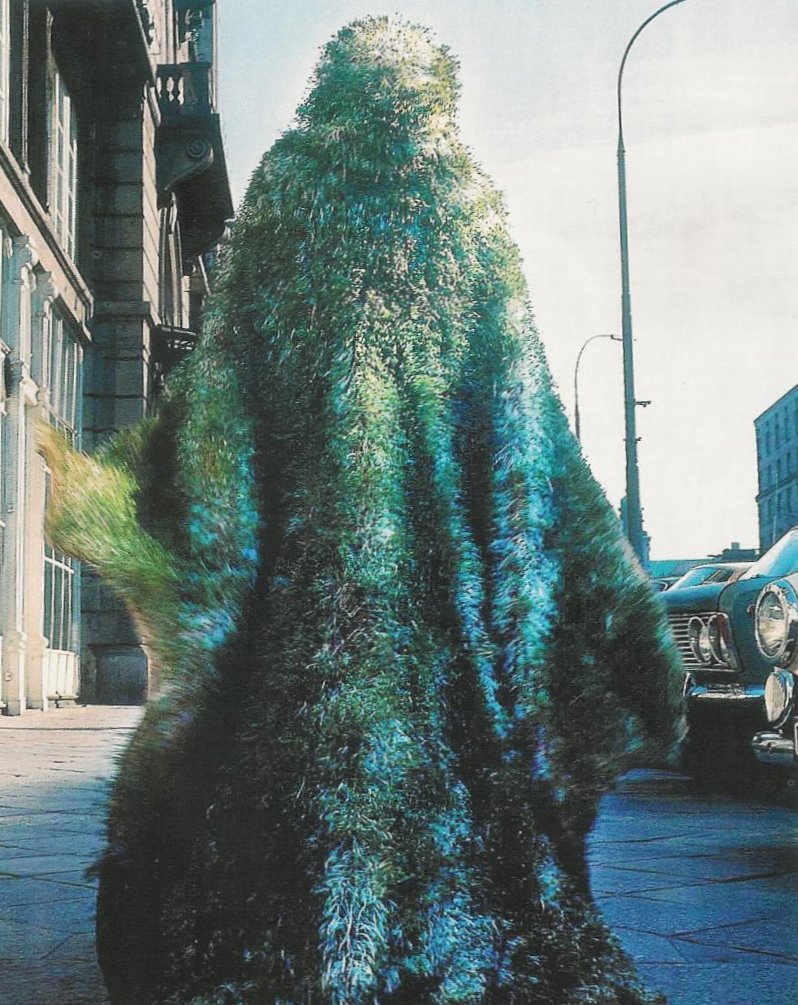 Teresa Murak, Procession (1974)
thank you Jan for the link!
UPDATE: The photo of the Grass Wheel is by Andre Forget, a Halifax-based photographer. I'm terribly sorry for not putting the credit before. It is often difficult to execute on the internet (to get to the original source), but it's mainly laziness, and not incapacity or bad will, that is to blame.

Sunday, July 9, 2006
Police in Berlin said on Wednesday they had arrested two men on suspicion of placing cement-filled soccer balls around the city and inviting people to kick them. At least two people injured themselves by kicking the balls, which were chained to lampposts and trees alongside the spray-painted message: "Can you kick it?"I agree with ann that the message seems unnecessary, but the work does have a pleasant, sadistic thing about it. Especially if you're living in a country like Portugal.
(via, originally from)
Number 4 on the list of things to do in order to concentrate on writing is "Stop with the blog already". That puts the blog in a rather bad position, doesn't it?
Friday, July 7, 2006

This was certainly the case with Romeo Castellucci's 4th episode of the Tragedia Endogonidia series - BR.#04 Bruxelles/Brussel, during the Alkantara Festival. And if I waited so long before writing anything, it was precisely because of that.
The state of I don't know is something to cherish. Whereas in everyday life it may be quite problematic, there is no reason for it not to persist in aesthetic judgement.
There is more. Contrary to many aesthetic theories, I firmly believe aesthetic judgement can change - and usually does! - after the aesthetic experience. We reevaluate what we saw, heard, felt, after thinking about it, but also, after receiving new information. That is why the conversations people have after shows are not, in my mind, just the need to share one's impressions. They are rather attempts at establishing some sort of relation between me, my view of things, and the way others see and feel them. And, since we are no monads, communication makes a difference. I've had shows which I didn't really appreciate but started to have liked after having discussions about them. This is probably quite natural in non-temporal arts, where we can come back to a piece and renegociate our relationship with it. But in time-based art it seems awkward, to say the least: how am I to have liked something I already didn't like when it took place? The "taking place" is what's misleading here. Things take place, but our judgement of them needn't stop when they do. Does this mean we are easily influenced? We can't make up our mind by ourselves? Yes. Isn't that great?
The problem is when we see something controversial, like Castellucci's production.

The theater, reportedly says Castellucci, is a space to show amazing events.
But what is "amazing"? Castelucci's amazing might actually come from a maze rather than from amazement. It is a dry, calculated construction, a sort of a post-Wilsonian theater of imagery. But where Robert Wilson opts for a sort of a postmodern surrealism, the Castellucci I've seen prefers semantic games with the "timeless themes": birth, death, violence, etc., directly going for the heavy-duty stuff. At the same time, his aesthetics is quite close to what we've seen in the Cremaster Cycle. The strong white light that's gloomy, the fantasy/mythological characters, the extreme slowness (they aren't only taking their time, but ours as well...), and what's most striking, the extreme ritualization of everyday activities. Actually, this passing onto the stage seems to be quite natural, as Cremaster had the performative and theatrical qualities that only maybe needed to be nourished with some sort of theater dynamics to make it a stage piece. Here, tragedy is what provides this dynamics. It raises the energy level, while keeping the aesthetics of unbearable purity unbearably pure. Castellucci's discovery here seems of some importance: you don't need the story to have the tragedy. Or do you? Although fighting away any clear narratives, BR#04 somehow goes back into them all the time: when a guard takes off his uniform, and lies nearly naked on the floor, to be beaten up by other guards, we get a very succint, but also very straight-forward story. More - it is actually a story with a moral! This is a crucial point that distinguishes Castelucci from Wilson or Barney. The latter two stay as far from moral, social or political issues as they can, while the Italian director goes directly into them. How does he survive? How does one survive combining a visual arts/ abstract world with dwelving into social matter? Cláudia Dias had one solution I particularly liked: being delicate and extremely personal while maintaining a rigid formal structure. Castelucci's structure is even more rigid and dry (almost lifeless!), but he chooses the exact opposite strategy to Dias: he becomes completely impersonal. The characters have absolutely nothing personal about them. The stories aren't stories, but flashes, hints of stories, sketches of narratives with a few grasping details. Thus, the "narratives" we see are at once complete - a guard undresses to become an anonymous person, who is thenupon abused by other guards - and inexistant - there is no reason for the abuse, no outcome, no difference between the people who beat and the one who is beaten, there is no beginning and no end, as the act of violence remains fairly similar throughout the scene. It is suspended, and we are allowed to link it to our entire imagination, memory... or not.
 And this is where the roads diverge. Do we accept this game of suspended scenes and create the stories ourselves, or do we demand something more than just live paintings? Do we see the crawling old man dressed in a bikini as a beautiful, engimatic and sad image, or do we see it as a naive metaphor? Is gratuitous violence meaningful because it shows the lack of sense, or is it simply gratuitous and therefore senseless? Are the strange characters that appear somewhere in the middle fascinating, or just cheap decoration? Is the baby that is left crying alone on the stage a great act of provocation, using the tradition of live art, or is it an irritating act of going back to something that has already been done but with stupid cruelty and a pathetic atmosphere?
I really cannot answer these questions. When leaving the theater, I asked a few friends about their opinions. An young actress said it was disturbing and moving. A performer said it was the worst thing he had ever seen. A choreographer said it was absolutely beautiful. An older actor who used to work with Grotowski said it was simply a stupid show pour épater les bourgeois.
more on Castelucci

Tuesday, July 4, 2006

Monday, July 3, 2006

Saturday, July 1, 2006
Forced Entertainment's shows during the Alkantara Festival were not a huge success. While the smaller, more intimate Exquisite Pain was discussed, adored by some, appreciated by others and disliked by others yet (as is to be expected of any show, let alone a FE one), The World in Pictures had the audience quite clearly disappointed. It was a flop. It was based on a fairly silly idea of telling the world history, as it is presented in children's books. The idea itself seems controversial, if not dubious. And the execution was messy, as it usually is in the case of the Sheffield group, but also somewhat timid, as if not daring to be really outrageous or controversial. The one thing that really stood out were the gorgeous monologues of the great Jerry Killick (an invited actor whom I can't recommend enough).
Nonetheless, Forced Entertainment are not only a reference. They are one of the very few actual stars in contemporary independent theater. And, although they have by now turned into a classic, they still dare to risk in new ways - and Exquisite Pain, a lecture of Sophie Calle's work with practically no "theatrical artifacts", is a great example.
What I was really curious about was what does it actually mean to be Forced Entertainment. Or to be Tim Etchells, the group's artistic director.
It's a fairly long interview, and it mainly reflects my own interests in directing, contemporary theater, its relation with contemporary art, and the possibility of change.

Vvoi> From the perspective of today, how do you see Forced Entertainment when it started 20 years ago?
Tim Etchells> We were a group of friends who somehow convinced ourselves that we would be able to make some things together. At the beginning, we were still students, and, in various combinations, we worked together and began to make things. Then, once we finished our studies, we started the company properly. But more than anything, at that point it was an idea or an inclination that we could perhaps make something together.
I suppose this feeling still continues if you’re still together.
Yeah, I guess so.(laughs) I suppose now it’s less speculative. It’s clear that we have some things to do and to talk about, a way to work together, whereas at the beginning I don’t think we could be so confident of that.
What other ways do you think you have evolved in?
There are technical things that change, like you develop some skills, some knowledge about what you do and how you do it, some understanding about what it is that you can do in performance or in other media, which of course you don’t really have in the beginning. And maybe what also changes is that you get more confident in the idea that you should trust your instinct, that you should go in whatever direction you think seems worth pursuing, though you can’t necessarily explain where your decisions are coming from or what’s leading you to do certain things. You have to trust your inclination, because in a way it’s all you actually have.
How does that work in a group? Your inclination is not necessarily the inclination of other members of the group.
The group is a very curious thing, because on the one hand it’s got lots of inclinations, since there are lots of people, and lots of people are constantly pulling and pushing the company in different directions. On one hand that means that there’s lots of potential, on the other hand it means that there are lots of things that get proposed get kind of shouted down or stopped. But what also happens, which is the positive side of that, is that anything proposed by one person is endlessly modified and augmented and added to and taken away from by other people in creative ways - as well as not so creative ways (laughs) - but basically, for us there is a sense that somehow what you can achieve together in that process is deeper and richer than what you could achieve on your own if you had simply followed one of those desires or inclinations.
Isn’t this a constant struggle, like you’re constantly fighting over ideas?I can imagine someone giving an idea and all the others saying “that’s not really what I was thinking”, so you start talking about it, arguing... Or do you just try it out?
We work a lot by trying things. In argument it’s possible to prove more or less anything, but when you do things in a rehearsal studio than the truth of the situation becomes clear fairly rapidly. One of the things we’ve learned, I guess, is to trust practice, is to trust doing things more than anything else. Ideas are fine, but people who’ve got a really brilliant idea, or a really brilliant theory, that’s one thing, but actually having something that you can do in the studio or in front of an audience and that actually works is a different thing altogether, in a way. We trust doing much more than we trust talking. Although we talk a lot, that has to be said. The thing that we really trust more than anything else is doing.
What happens if it fails you? And how do you know?
It’s normally pretty clear to us that there are problems with something if there are problems. If we do improvisation in the studio and it’s crappy, than we can tell... (laugh) we think we can tell.
Does it ever happen that you discover it after the show has started touring?
Of course, when shows open, there are always things that need greater articulation, or which need to be cut. That happens all the time.
So I could go and see your show after your touring it and hardly recognize it?
Not normally. Normally in the first month of touring, there’s a process whereby things get changed or, even when we’re not trying to change them, they settle into a way of being done in front of audiences which is different and which happens in response to the situation of being in public and having to communicate the peice to audiences. That will change, but it’s pretty rare that a piece will change substantively. We make a lot of small changes which make a great difference to how a piece will work, but wholesale, major changes are pretty rare. Maybe once or twice in the last 20 years you could say that.
In this sort of devising process, what does it mean that you “direct” the group?
In some ways it’s a kind of an organizing job - it’s like being the chairperson of the group: I’m watching and I’m listening and I’m trying to hear what other people are saying and trying to make sure that we together consider things in as many different ways as possible, that we’re thorough and clear together about what we’re doing. I guess, in another way, I’m doing something that’s much more like normal direction: I’m watching and if I think things are working than I’m saying so, and if I things are not working than I’m saying so. But I’m usually doing that in order to open a discussion with the group. It’s not this kind of model of Robert Wilson, or someone who’s drawn the whole show in his head before anybody arrives. It’s entirely more collaborative and discursive somehow.
And do you ever feel you have to say “no, that’s it, this is what we’re going to do”?
Not really, no. Another thing we have is a model of working based on the idea that you should come to decisions rather than make them. That means basically, we just try a lot of different things, different possible solutions to things. Sometimes we’ll try all of them. It may take us some time. But in the end of that process there’s usually a shared opinion from the group about what works and what doesn’t work and about which way to push things. So it’s pretty rare that I would have to say that I... and in a way, even if that kind of thing gets said, I think it’s a very temporary thing. You say: “Well, so today, we’ll do that”, because it’s 6 o’clock and the show is at 8 (laughs). I think we’re very good at knowing when to make these pragmatic decisions. In the process we have this thing where we say, well, if we had to do the show tonight, this is how it would be. And that’s a very good way of learning and undersanding the material that you have - to put it under that kind of scrutiny.
This idea has actually become famous. I’ve heard about it and I think it’s something that you might have planted and that has grown all around the world. It’s quite an effective method.
Thank you.
I suppose the world of theater today is very different from when you started. There are many new groups that have developed their work learning from you and using your work as a starting point. Does that change your perspective, your situation? And are there any groups that you like particularly?
I don’t think I see enough of the work that’s coming from younger artists to know much about that. But for me the work that I’m most excited about when I encounter it is work that maybe has a very strong relation to what we’re doing, but it actually comes from a very different place. So, for me, the first time I encountered the work by Jérôme Bel about 15 or 12 years ago - I could recognize a lot in Jérôme’s work, but of course it’s completely different. Or when I saw Richard Maxwell from New York and his work - again, it’s totally different, it’s plays, it’s drama, it’s characters, but there’s something about how he’s dealing with performance and with a certain kind of dead-pan thing, that we could recognize very rapidly. The work that we tend to get excited about is the stuff that’s a bit of a jump away from what we’re doing. It’s often coming from dance - if you think of Jérôme, or if you think of Meg Stuart, or it’s coming from plays, in the sense of Richard Maxwell...
How about visual arts?It seems like the contemporary art scene somehow developed its ‘performance side’, so maybe it got closer to where your directions?
In a way that’s true. On the whole, I probably feel more affinity and closeness with people who are working in visual arts, in projects like that, than I do with people who are working in theater. Although there’s something about the group thing...the other thing that we tend to feel very close to is to do work collectively. Historically, encountering Richard Maxwell and his group, Stan from Belgium, Goat Island from Chicago. Often it’s something about recognizing this rather difficult and strangely social, in a way quite wonderful, in a way absolutely impossible, situation of working so closely with other people that seems to be at the heart of theater and performance. You don’t get that so much in visual art. Those are mostly people working solo, with a very developed and schooled sense of their own ego and their own vision - and themselves as a kind of commodity. That’s very different from the existence that we have when we are working in a group of 6 or 8 or 10 or 12.
So how does it relate to your solo projects? I know you have these lectures that you give quite often. Have you made other types of solo performance?
I made a solo performance performance, which is somewhat on the lighter side of things, in 2000 I think, which was really good to do. And I do a lot of stuff on my own - I write, and I’m also working on art projects...
What projects?
Installation, and text pieces in a visual art context... Or neon... really a bunch of different things in a gallery context.
Neon? Did you say neon?
Yeah. Text pieces.
Uhuh. I see.
I’m working on two things for Graz* in September, small projects that are part of a group exhibition. One of them is a project of collecting stories and songs from people, and another piece which is a set of instructions for visitors to the museum. They’re given it in a sealed envelope. Every person gets one instruction. So I’m also very happy to work in this way that’s much more private and solo. In a way it’s a necessary escape from being in the room with all those people all the time.
How do you find time for all of this? Do you have a life outside of that?
Not as much as I would like. (laughs)
But even without that much of a life, how do you manage all these things?
I’ve just got very good at working in the cracks of other projects. So while I’m doing one thing, I can usually be trying to do two other things at the same time. And I got very good at working in hotels. And I got very good at working on the airplane. And I got very good at working when I shouldn’t work any more (laugh). A lot of people are very sensitive, they’re like “I can’t work when I’m at home”, or “I need all my things”, and I’m really like, if I have got my laptop, and probably an internet connection, I can be working. I really don’t need almost anything else. In a way that’s how my work has evolved. It’s grown to fit into this circumstance where there’s a lot of things going on. I tend to find time in and around, in the cracks.
I don’t know how it feels for you, but for me Forced Entertainment is a very famous group. How does it feel, and what does it mean?Does it translate into, say, people recognizing you, and writing you e-mails...?
[This is where my minidisk ended. And I didn’t dare to admit it or interrupt my famous interlocutor. So for a few minutes, as I was trying to find an alternative way of recording, I wrote down whatever I could catch from Tim’s answer. Here is what is left:]
...a bit of e-mails...
...within a context...
...we have a profile...
...but the context is hopelessly small...
...In the real world, nobody heard of us.
[back to recorded dialogue]
Do you think there’s an alternative to this? Some solution, some way the independent theater can get through?
I think no. In our work there’s a sort of fundamental awkwardness. And this awkwardness is what stops it from traveling or progressing into the main stream too far. Because there is always something a little bit uncomfortable, or a little bit difficult, or a little bit confrontational... Whichever way you look at it, one of the interests in what we do is in creating a certain kind of uncertainty, or putting pressure on the audience.
For a lot of people that’s hugely enjoyable and valuable: that’s what they want. That’s why they keep coming to see us.
Maybe it has also to do with the way that the work is marketed or positioned in the culture, but this awkwardness is a bit of a problem. I mean, I don’t think it’s a problem, but if what you wanted was a broader, bigger, more popular base for this work, than that’s the thing that would screw you.
But I think that’s actually pretty key to what we do, so I don’t really see that changing.
We’re not Complicite. Complicite, in the end, can do a deal with the National Theatre in London and there’s nothing really threatening there. There’s nothing really difficult. It’s interesting, it’s sort of experimental, it’s got ideas in it...
But it doesn’t make you feel... weird (laughs). Or, it doesn’t give you a hard time. And even if we want to make very nice, funny , popular thing, which we sometimes say that’s what we’d like to do, but there’s something about us and the work that we do that can’t resist the temptation to make life difficult. So I think that’s the thing that at one level sets us into the way the work could go. Maybe.
This sounds like a pretty dramatic choice.
It’s not really a choice. It’s about making the work that you want to make. And about making the kind of interventions with your work that are important to you. If I look around, maybe in some of the work that follows us, I can think: yes, maybe it’s quite good at following the formal strategy that we make, but what it lacks is that difficulty - and that’s what I really can’t bear about it - I’m not interested any more. I’m interested in causing trouble at a certain level.
And don’t you ever get tired of causing trouble?
No! (laughs) Well, maybe. Yeah, I don’t know. Apparently not. (laughs slyly)
Maybe we get better at causing trouble, and trying to do that in a way that brings people along with you. We’re not talking about some sort of idiotic attempt to shock or drive the audience out of the theatre. For me, shows like Bloody Mess, or The World in Pictures, or First Night, what they’re trying to do is to work in a very seducing and comical and playful way with theater, and at the same time take audiences into trouble, take them into difficult places. For me, this balance, this attempt at doing both of those things at the same tame, that’s what is really important.


