


|
|---|


Tuesday, May 30, 2006
A few pretty things:
- Recommended by a reader: horizon magazine, the last issue being focused on retro digital art.
- Found via Infosthetics: State of the Union by Brad Borevitz, a visual analysis of all the State of the Union speeches, from George Washington to George W. Bush. You can see the vocabulary analysis, the relative importance of each word, and even see each of the speaches with the selected word hilighted. This is very instructive, scary, impressive. You see the history of a true power through the lens of a precise moment. These speeches are incredibly political, they are propaganda, and they show in a surprizingly clear way the evolution of the social mind, the social consciousness. These words, some of them highly charged concepts ("peace", "struggle", "leadership"), others apparently simple and trivial ("American", "must", "but"), often tell the stories better than the sentences they are part of. One of them surprized me the most, and I'm not sure it should be included in the analysis. In the G.W.Bush speeches, the most frequent word is "applause". Which, of course, is the applause of the public, transcribed. Was there no applause when the other presidents spoke? Then why suddenly do we need to be reminded of it, time and again?
- Finally, via Happy Famous Artists, someone I haven't heard from in a while: Pipilotti Rist. This punkish, trashy video artist (see here and here, with a fragment of the famous I'm Not the Girl Who Misses Much) has a punkish, trashy web page with some really nice images (great sense of space!), and a few projects... Obviously, it's hard to understand or follow, but you get it, don't you? Rist was really the precursor of the Vanessa Beecrofts and other "post-feminists". Interesting to see how she still uses the punk esthetics to her favor.

Thursday, May 25, 2006
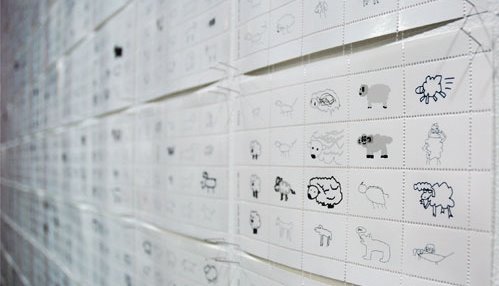
The Sheep Market, by Aaron Koblin, seems like the cutest thing in the world: a collection of 10 000 sheep drawn by people from all over the world.
#1. Don't ignore it as I nearly did.
#2. This is not about lots and lots of different drawings that create one cute whole.
#3. It has more to do with economics.
#4. And dreaming.
#5. Maybe it has to do with the economics of dreaming?
Here are some hints: Each drawing was paid 2 cents. The name is Sheep Market. The short description says "10,000 sheep created by online workers". One of the 8 pieces of data we get in the long description is the "Average wage". It's $0.69/hour.Is this a political statement? Oh, let us not reduce everything to simplistic, social terms.(Although I must mention that in an interesting e-mail he sent me, the author, Aaron Koblin, mentions Marx and Engels).Notice that if you put the cursor over any given sheep, above you get an exact reproduction (animation) of how it was made. "Within the inspiration for The Sheep Market is the urge to caste a light on the human role of creativity being expressed by workers in the system, while illustrating the massive and insignificant role each plays as part of a whole.", writes Aaron.
The ambiguity of using paid workers to do an artistic job reminds me of the earlier works of Santiago Sierra (paying people to do various, sometimes humiliating, things). Only here, several factors seem new: contrary to the classical taylorist ideas, there is no specialization. And contrary to Sierra's workers, these here are plainly, positively anonymous, faceless, nameless. I've tried to find a signature. I think I found one. Also, the work itself has another dimension: where is it? How can it be used? The author decided to make stamps out of the drawings. He could have used it in any other way. The people behind it simply vanish. It might seem ridiculous, given the amount of effort they were asked for. After all, Sierra tattoos his workers, Vanessa Beecroft makes her "models" undress... while here, all they do is draw a tiny, funny little thing. Probably not for money, but mainly for fun, or just to do something, or for whatever reason. But the work of art seems to have a quality, a certain opacity about it, that allows it to showcase some hidden traits of the (social, economic) systems that we commonly ignore. And thanks to the symbolic work we always do when reading a work, we easily go the distance that separates the sheep from any other task. After all - it's the system we see, not its elements. In this case, the system happens to be a work of art. And a pretty one, too. Full of lightness, humor. Very user-friendly. Aaron Koblin quotes The Little Prince: ’If you please--draw me a sheep . . .’ Looking at the rows and rows of sheep (notice the plural is the same as the singular), I associate it more with the ones we try to count when fighting to fall asleep. Only this time - 2 cents a piece. Or, if you're on the consumer end, $20 for a block of 20 certified stamps.
Oh, and actually, forget #2. I changed my mind. It is also about lots and lots of different drawings that create one cute whole.

At the Canadian Museum of Contemporary Photography.
ps. David Bierk was the father of Sebastian Bach, leader of the band Skid Row. So strange...
Wednesday, May 24, 2006


Michal Macku makes me think of Abakanowicz and some of Beksinski's later works. Both of them are Polish - and Macku, Czech. He is quite Central-European, I suppose. There is this heaviness about the body, the despair, but a despair that becomes poetic, beautiful, that frees us from itself. He also reminds me of the Portuguese Helena Almeida in his plays with the form, the frame, the "content". But Almeida is much more conceptual, she likes lines, pure forms. Macku goes for the distortion, he seems attracted to the surrealist dream of an un-body, a body that outdoes itself, that lives an autonomous life. I suppose this could be a proof of the existence of the soul, through the negative: if we can imagine a living, functioning body without a soul, and it is different from who we are now, than we need something to describe what we are now. The technique Macku developed, which he called "gellage"(a collage using gelatin), leaves no doubt: this is not digital. This is all too real, we almost hear the fabric tear, we sense the bodies come together and seperate. Of course, one could do it digitally. But this once, let me stay with my old-fashioned analogical rhetoric.
You also need to see his newest type of work, "glass gellage", 3-dimensional glass installations. See the flash animation here.
(via the excellent Art of Love blog)
Tuesday, May 23, 2006

C-print (2006)
C-print (2006)
Body, fetish, play, artificial, coherent, multiple, rhythm, together, covered, surrounded, created, creation, dance, dance, you monster, you, monster, proportions, Saturn, or Kronos, who ate his own children, birth of time, body mass, mass grave, pointing down, pointing down, pointing down.
ps.: I discovered a somewhat similar other, older suit by Jean-Charles de Castelbajac through this. I prefer this one by far, though, although it's so creepy. And, in case you wondered, what's on sale here are the pictures, not the clothes. ($2300 a pic...)
(via)
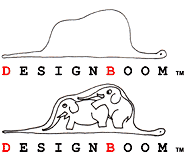
An entry by Ernesto Oroza from Cuba, at the designboom contest for their new logo.
Monday, May 22, 2006
For the conceptually-minded: #404, by Jon Meyer, a tribute to John Cage's 4'33". I must admit I am not quite in the disposition for artsy fun and thus skipped this silence, but you might just not be me.


